

Which Organ Can Repair And Regenerate Itself
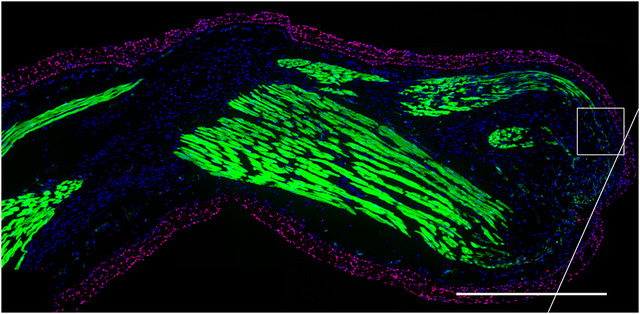
In that location are many animals that can regenerate circuitous body parts with total function and form afterward amputation or injury. Invertebrates (animals without a spinal string) such as the flatworm or planarian can regenerate both the head from a tail slice, and the tail from a head piece. Among vertebrates (animals with a spinal string), fish can regenerate parts of the encephalon, middle, kidney, heart and fins. Frogs can regenerate the limb, tail, encephalon and eye tissue equally tadpoles but not equally adults. And salamanders can regenerate the limb, middle, tail, brain, heart tissues, kidney, brain and spinal cord throughout life.
How practise these regenerative animals regrow such circuitous structures? After amputation, stem cells accumulate at the injury site in a structure called the blastema. An important bailiwick of ongoing research is how signals from the injury site cause the stem cells to form the blastema and starting time dividing to rebuild the missing part. And what most the stem cells themselves? Practise the animals use a single blazon of stem prison cell in the blastema that can differentiate into many different types of tissues (called a multipotent stem cell). Or is a split set of stem cells responsible for making each of the different tissues needed to brand up the new trunk part?
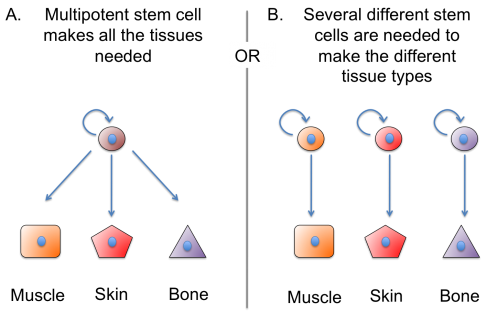
Contempo inquiry in unlike regenerating animals has shown that there are various stem jail cell strategies for regenerating body parts built from multiple tissues, such every bit muscle, nerve and pare. If we understand the principles and molecules these animals employ to regenerate developed tissues, can these lessons be applied to regenerating or technology human tissue?
Scientist Peter Reddien'south research grouping in the USA recently solved a long-standing question in planarian (flatworm) regeneration – can a single stem jail cell regenerate a whole animal? The respond is yes, it can. This shows that adult planaria accept pluripotent stem cells – cells that can brand ALL the prison cell types of the animal's body. How these pluripotent cells are controlled in the flatworm's body then that they do not course tumors is an important question that several research groups are now studying.
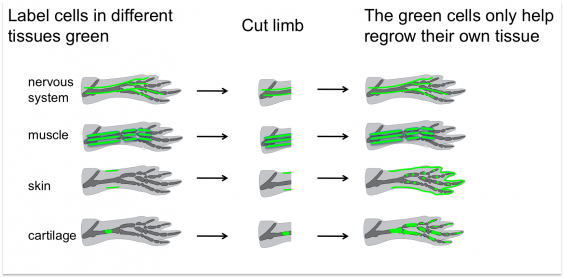
But not all animals utilize pluripotent cells in regeneration. The stem cells that regenerate a frog tail and a salamander limb take very different backdrop from a planarian stem prison cell. In these animals, each tissue – such as muscle, nerve, or peel – has its ain prepare of stem cells that just brand the dissimilar types of cells in that particular tissue. In other words, a muscle stem cell cannot make skin and skin stem cells can't make musculus. These multipotent tissue-specific stem cells are probably very like to the stem cells in our own bodies that renew or repair tissues such as our skin or muscle. Why tin such stem cells regenerate an unabridged limb in a salamander, only but repair impairment to a single tissue type in our ain bodies? This is another question that scientists are working on now.
As well as using stem cells, regeneration can work past causing differentiated cells that had stopped dividing to 'go back' to dividing and multiplying in order to supersede the lost tissue. This has recently been shown to happen in heart regeneration in zebrafish, where a heart muscle cell called the cardiomyocyte divides to replenish missing cardiac tissue. This regenerative miracle has likewise been found in newly born mouse hearts, merely is chop-chop lost as the mice mature. More research is needed to understand how differentiated cells tin can exist fabricated to dissever and produce new heart tissue, and why this capacity is lost in humans.
Past defining the properties of stem cells that regenerate circuitous body parts, scientists are learning how injury causes these stem cells to regenerate the missing role instead of just forming scar tissue. Future research may make information technology possible to apply this cognition in new kinds of medical treatments.
Pluripotent stem cells
How similar are the pluripotent stalk cells of the planarian to mammalian embryonic stem cells or induced pluripotent stem cells? By studying the planarian, maybe we will gain insight into how to control human embryonic stem cells to replace parts of our own bodies.
Tissue stalk cells
Salamanders and frogs employ tissue stalk cells that may exist much like our own, and then why tin they regenerate a whole limb whereas we form scars? Ongoing research indicates that regenerative animals keep a kind of map inside their adult tissues, telling cells where they are and what they should be. Parts of this map may have been lost in mammals, or perhaps our stem cells have lost the ability to read the map. Researchers hope to discover out what exactly is missing or blocked in mammals, and whether such information can be restored to direct stem cells to take part in regeneration for medical applications.
Differentiated cells
Can we make adult, differentiated cells like heart muscle cells start dividing again, as in the zebrafish? It will exist important to find out why mammalian heart cells lose this ability, and if information technology tin can be restored.

Source: https://www.eurostemcell.org/regeneration-what-does-it-mean-and-how-does-it-work
Posted by: hunterlithend.blogspot.com
0 Response to "Which Organ Can Repair And Regenerate Itself"
Post a Comment